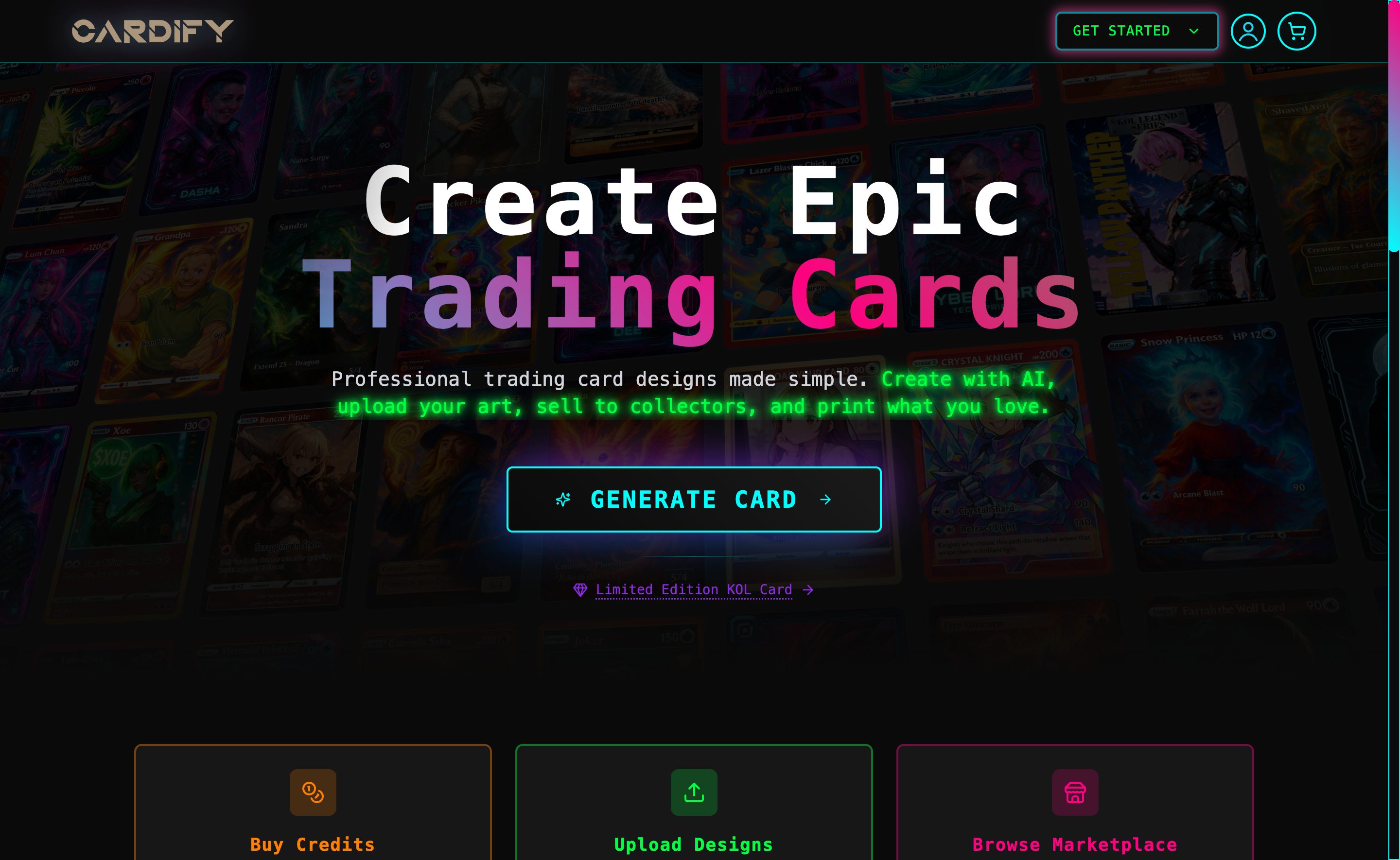
AI-powered trading card platform with a custom multi-model image pipeline, nano banana powering the in-app editor, a 3D card-slab viewer, and a full creator marketplace. Built for its founders from an idea, no visual rough draft.
Cardify isn't slotting into an existing category — it's trying to create one from nothing. There's no incumbent to clone, no reference product to point at. The founders had a clear pitch — physical AI-generated trading cards with a card editor, 3D preview, marketplace, and creator-economy payouts — but no prototype, no visual mockup, no chosen image model, no backend schema, no editor, no 3D viewer, no commerce path, no fulfillment plan. Even the basic question of which image model could actually produce something printable as a trading card hadn't been answered. Every layer needed to be designed and built from a blank page, taking direction from the founders on product intent and shipping the engineering, design, and AI-model decisions ourselves.
The Notus designed and built the entire product from blank file. The image question was central, so we spent real time testing the current generation of image and image-editing models against the actual job of producing something printable at trading-card dimensions, and landed on a custom multi-model pipeline with one engine per job: one for generation, nano banana for the conversational in-app editor (with a pre-distortion step we wrote after testing surfaced an aspect-ratio bias), and a third for masked inpainting with a browser mask painter and a custom analyzer that translates painted regions into prompt language. Around that pipeline sit four card editors, a Three.js card-slab 3D viewer, a Supabase backend with 22+ tables, a full marketplace with creator-economy payouts, dual auth (email and Privy wallet), dual payments (Stripe and crypto), a custom LPIPS duplicate-detection service on Hugging Face Spaces, and an n8n workflow for Stripe → Easyship fulfillment.
Cardify is live at cardify.club. Users sign in with email or a wallet, generate a card, refine it conversationally inside the nano-banana-powered editor or surgically with the inpaint mask painter, see it rendered as a real 3D card-in-slab object, list it on the marketplace, and either get paid out in credits or cash through Stripe. The credits ledger has never double-credited a Stripe payment because the duplicate-detection happens at the database insert, not in application code. The LPIPS service catches near-duplicate uploads before they pollute the marketplace and routes ambiguous cases to a human review queue. The fulfillment glue runs unattended every 12 hours. The product the founders described in the first call now exists end-to-end, designed and built from the blank file outward.
AI-aggregated business intelligence across 107 topic verticals. Rebuilt for its founder from a Google AI Studio visual shell with no backend, no database, and no workers.