Our own songwriting app, designed and built from a blank file: one React codebase that ships to web, iOS, Android, and inside DAWs as a plugin, with custom melody detection and offline word tools.
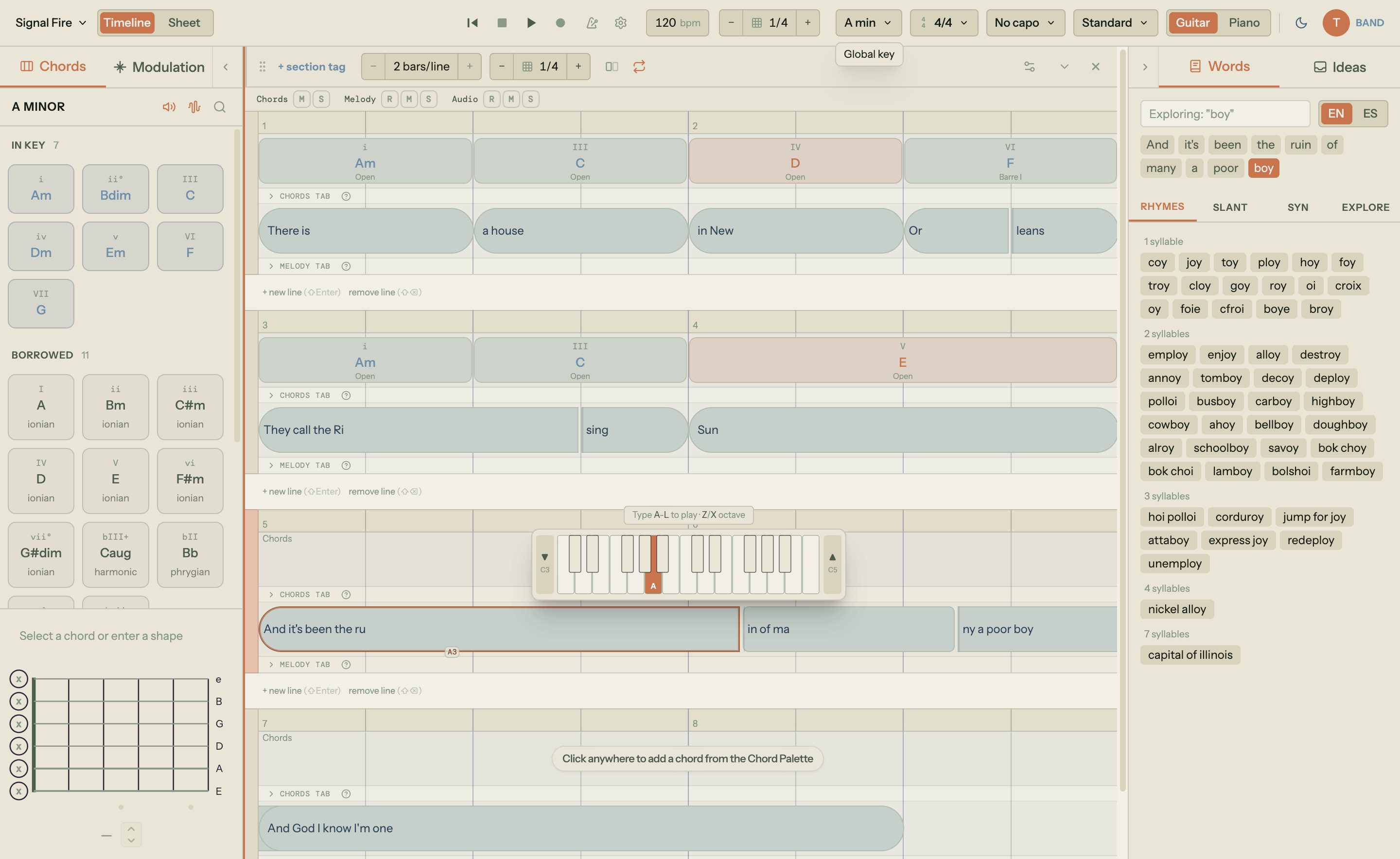
Song Cage is where the Notus standard comes from. We wanted a songwriting tool built for the guitar-in-hand moment: a DAW-style timeline where chord blocks, lyric blocks, melody notes, and syllable splits all live on the same grid; a music-theory layer that suggests borrowed chords, secondary dominants, and voice leading without making the songwriter learn theory first; offline word tools that surface rhymes, slant rhymes, and word associations the second the cursor lands on a line; and one product that ships to the web, to a phone, and to the inside of a DAW. Nobody had built it, so we did, on our own money and our own deadline. Every claim we make to clients (production engineering, multi-platform shipping, AI visibility) got proven here first, where we couldn't blame anyone else.
We designed and built the entire product from a blank file. The whole thing runs from one React codebase that ships to the web (Vite + Cloudflare), iOS and Android (Capacitor), and inside DAWs as an AU/VST3 plugin (JUCE 8 WebView), with PowerSync handling local-first sync so the same song shows up across surfaces without a round-trip. The melody pipeline runs a neural singing-transcription model on-device, with a TypeScript port of librosa's pYIN kept in the bundle as a zero-download fallback and a user-selectable engine; both feed the same onset-aware segmentation, amplitude gating, and snap-to-scale, and both are scored against the same vocal benchmark so a swap is a measured decision rather than a guess. The music-theory layer is roughly 39 modules covering chord classification, key detection, voice leading, borrowed chords, and capo transposition. The word tools work offline from shards we built out of CMU, WordNet, and GloVe data. The AI-legible Astro marketing site, the Stripe reverse-trial billing, and the Resend drip flows shipped alongside.
Song Cage is live at songcage.com, on the iOS App Store, and on Google Play, as a downloadable Mac and Windows app, and as an AU/VST3 plugin that loads inside a DAW: one codebase, five distribution surfaces. 95 desktop and plugin releases have shipped since May, every one of them dated publicly at songcage.com/changelog. 800+ people signed up before a dollar of advertising was spent. ChatGPT began citing Song Cage for "best songwriting app" within seven days of launch, drawing from the AI-legible Astro marketing site we built alongside the product. Perplexity and Claude started citing it in the same window. The unglamorous infrastructure underneath (the PowerSync offline-first sync, the melody pipeline that holds across Safari and mobile WebKit, the offline word-tools shards, the Stripe reverse-trial flow, the schema markup and llms.txt on the marketing site) is what makes the product behind those citations actually hold up.
Our own product: personalized photo puzzles for kids. A parent uploads a photo, picks a magical world, our AI repaints the child as its star, and a premium jigsaw prints and ships to their door.