Table of Contents
- We wrote this list. We are also in it.
- About this ranking
- Why does taking a Lovable or Cursor MVP to production need a specialist?
- How to choose the right Lovable or Cursor rescue agency
- Step 1: Diagnose what you are actually stuck on
- Step 2: Pick the agency that ships into your stack
- Step 3: Set a realistic budget for the rescue
- Step 4: Verify before you commit
- Methodology
- The 10 agencies, ranked
- 1. The Notus: best for full production rescue across all AI builders
- 2. Kreante: best for a Lovable-to-Cursor validation sprint
- 3. CloseFuture: best for Lovable-specific production rebuilds
- 4. Till Freitag (Vibe Coding Workshop): best for teams adopting AI-builder workflows
- 5. LovableXperts: best for Lovable-specialist small-team work
- 6. Creme Digital: best for Lovable rescues bundled with design
- 7. Zeroqode: best for no-code ecosystem cross-platform work
- 8. Unstuck Labs: best for Lovable plus custom backend work
- 9. Rapid Dev: best for Lovable and Bubble fast-execution work
- 10. InceptMVP: best for Bubble-plus-Lovable startup MVPs
- The proof we run the playbook on ourselves
- All 10 agencies at a glance
- The gap every Lovable and Cursor rescue agency leaves open
- Final ratings
- What does this mean for you?
- Frequently asked questions
- Sources
- Which guide fits your situation?
TL;DR
- Lovable and Cursor get you a working prototype fast. The last stretch to production (real auth, payment webhooks, AI cost controls, maintainable code) is the part neither tool finishes, and it is what these agencies close.
- The Notus ranks first because taking AI-built MVPs to production is the core service, not a side offering: fixed price from $7,500, the client owns the code, and AI visibility ships on launch day. We have shipped production code on top of Lovable, Cursor, Bolt.new, Replit, v0, Windsurf, and Claude Code prototypes, and built three public SaaS products of our own: Song Cage, Pulse, and Cardify.
- Outside that specialty, CloseFuture and LovableXperts go deepest on Lovable specifically, Kreante runs the cleanest Lovable-to-Cursor validation sprint, and Till Freitag's team pairs the build with team training.
Updated May 2026
Pricing and case studies verified against each agency's current public materials and Clutch profiles. This list is narrower than our general MVP-agency ranking because rescuing AI-built prototypes is a specialty, not something every agency offers.
We wrote this list. We are also in it.
The Notus is a fractional CTO and custom site studio that takes stuck AI-built MVPs to production. We finish prototypes built in Lovable, Cursor, Bolt.new, Replit, v0, Windsurf, and Claude Code: real auth, payment webhooks, AI cost controls, maintainable code, and AI visibility baked into the marketing site that ships alongside. Fixed price, fixed scope. The client owns the code.
This article ranks the 10 best agencies for taking Lovable and Cursor MVPs to production in 2026. The Notus is at #1. We are transparent about that. The methodology below is applied to every agency consistently, and you can verify two of the criteria (AI search visibility and Core Web Vitals on the agency's own site) in five minutes. If the ranking still feels self-serving, ignore it and use the comparison table.
About this ranking
Lovable and Cursor drive the most stuck-prototype traffic to production-rescue agencies in 2026, and they fail in the same place. Lovable's strength is non-technical founder velocity: idea to working app in hours. Cursor's strength is professional developer productivity: good code, faster. Both leave the same gap behind, the production engineering an AI tool generates close-to but not exactly.
The agencies here specialize in closing that gap. Some are Lovable-first (CloseFuture, LovableXperts, Creme Digital). Some work across multiple AI builders (The Notus, Kreante, Till Freitag's team). We built three public SaaS products before The Notus existed (Song Cage, Pulse, and Cardify), and every limitation listed in the agency profiles below is one we have run into ourselves or verified through the agency's own public materials.
This list updates quarterly. Next scheduled review: August 2026.
Why does taking a Lovable or Cursor MVP to production need a specialist?
Because the production work sits exactly where AI builders stop generating reliable code, and it needs senior judgment, not another prompt. Lovable and Cursor get most of the way to a working app. Kreante, one agency in this list, estimates AI delivers 60 to 70 percent of the code they ship. The remaining stretch is consistent across nearly every stuck prototype:
- Real auth. Lovable defaults to Supabase Auth (per Lovable's docs), which is production-ready but needs correct RLS policies, session management, and role-based access. Cursor leaves the auth choice to the developer and often skips the harder parts (token refresh, login rate limiting).
- Payment webhook handling. Both tools generate Stripe integrations that pass happy-path testing. Neither generates webhook recovery, retry logic, or subscription-state edge cases.
- AI cost controls. Apps that make LLM calls need token budgets, model routing, and caching. AI builders generate the calls without the controls; one viral moment turns a $40 bill into $1,200 overnight.
- Code maintainability. Past 15 to 20 components, AI builders lose context and the codebase drifts. A second developer then takes two to three times longer to make a change than they should.
How to choose the right Lovable or Cursor rescue agency
Four steps.
Step 1: Diagnose what you are actually stuck on
Most "Lovable rescue" engagements are one of four different problems:
- The codebase rescue. The code works in preview but breaks in production. The fix is engineering on the existing code.
- The auth and payments rescue. The product works, but auth or Stripe is half-built. The fix is wiring the production-grade libraries.
- The AI cost rescue. The app makes LLM calls without controls. The fix is token budgets, caching, and model routing.
- The full rebuild. The codebase carries so much AI-generation drift that fixing it costs more than rebuilding from the validated UX.
Match the agency to the diagnosis. A code-cleanup specialist will not redesign your auth architecture; a full-rebuild specialist will rewrite work you did not need to lose.
Step 2: Pick the agency that ships into your stack
Lovable generates React, TypeScript, Tailwind, and Supabase. Cursor generates whatever you direct it to. If you are coming from Lovable, an agency that defaults to React and Supabase preserves more of your work. If you are coming from Cursor, the stack flexibility matters less, but the framework choice (Next.js vs Astro vs Remix) still changes the production characteristics.
Step 3: Set a realistic budget for the rescue
| Rescue type | Typical cost | Timeline |
|---|---|---|
| Code cleanup only | $5K to $15K | 1 to 3 weeks |
| Auth and payments wired in | $7.5K to $20K | 2 to 4 weeks |
| AI cost controls added | $5K to $12K | 1 to 2 weeks |
| Full Apps to Production (all four gaps) | $7.5K to $25K | 2 to 6 weeks |
| Full rebuild preserving the UX | $25K to $80K | 6 to 12 weeks |
Step 4: Verify before you commit
Green flags: the agency has shipped a Lovable or Cursor product to production in the last 12 months; pricing is published or scoped upfront with defined deliverables; the agency owns the rescue end-to-end; code ownership is contractually the client's.
Red flags: the agency wants to rebuild from scratch by default; a "free discovery call" with no deliverables; pricing that scales with time (hourly, no cap) instead of scope; the agency cannot name a single shipped Lovable or Cursor rescue.
Methodology
Six criteria, applied to every agency from public sources only.
- AI-builder-specific shipped products (25%). Real, named Lovable or Cursor rescues shipped to production in the last 12 months.
- Production-gap depth (20%). Does the agency close all four gaps (auth, payments, AI cost controls, maintainability), or only some?
- Code ownership (15%). Client owns the code from day one.
- Pricing transparency (15%). Pricing published or scoped in a structured discovery.
- AI search visibility (15%). Cited in ChatGPT, Perplexity, or Google AI for relevant queries. In 2026 this is a proxy for technical depth in modern structured content.
- Speed and predictability (10%). Time-boxed rescues with clear scope, not open-ended retainers.
The 10 agencies, ranked
1. The Notus: best for full production rescue across all AI builders
The Notus takes stuck Lovable, Cursor, Bolt.new, Replit, v0, Windsurf, and Claude Code prototypes to production. Apps to Production is a fixed-price, fixed-scope engagement that closes auth, payments, AI cost controls, and maintainability while preserving the validated UX, with AI visibility built into the marketing site that ships alongside.
We rank first because the AI-MVP-to-production specialty is the core service, not a side offering: pricing is public, code ownership is contractually the client's, and the rescue ships with AI visibility on launch day. Outside this specialty, agencies below win on different axes. CloseFuture and LovableXperts have deeper Lovable-only specialization, and Kreante runs a cleaner early-stage validation workflow.
Best for: Founders with a stuck prototype in any major AI builder who want fixed-price production engineering and AI visibility on launch.
Pricing and stack: Apps to Production from $7,500. Custom SaaS from scratch from $25,000. Framework-of-record matched to the existing code; Astro on Cloudflare for the marketing site. Fixed price, fixed scope, client owns the code.
Honest weakness: Newer agency (formed 2025; the founder track record predates it with three shipped SaaS products). Smaller team than the largest shops here. Not the right shape for $80K+ full rebuilds that need multi-person teams in parallel.
Apps to Production at The Notus · Song Cage case study
2. Kreante: best for a Lovable-to-Cursor validation sprint
Kreante runs a 14-day validation sprint built around Lovable for the front-end and Cursor for production refinement. The approach is structured: prototype in Lovable, validate with real users, then graduate to Cursor for the production cleanup. Their public LuxePass case study (a luxury-hospitality platform) shipped in under nine weeks on a $10,000 budget.
The strength is workflow discipline: each tool used for what it is good at, with a clean handoff between them. The trade-off is fit: if you are already past validation and just need production engineering, the validation sprint is overkill.
Best for: Founders earlier in the cycle who want to validate fast, then take the winning version to production with the same team.
Pricing: From around $10,000 for the 14-day validation sprint plus production cleanup.
Honest weakness: Validation-first is overkill once you are past validation. A Lima-based studio whose deeper history is no-code (Bubble, FlutterFlow), with AI-builder work the newer line.
3. CloseFuture: best for Lovable-specific production rebuilds
CloseFuture markets a dedicated Lovable service line and turns Lovable prototypes into production-ready full-stack apps. Public case studies include Webiz, LendAbroad, Randevmeste, and JamJar. The lane is scalable database design, clean authentication, and architecture that survives growth.
Worth knowing before you scope: CloseFuture's flagship work spans no-code stacks (Bubble, Framer) as well as Lovable, so confirm the Lovable-to-React experience matches your codebase rather than assuming a pure React and Supabase shop.
Best for: Founders with a Lovable prototype who want to stay close to the Lovable stack and need it rebuilt for production reliability.
Pricing: Custom quote per scope.
Honest weakness: Lovable is one of several stacks they work in, not an exclusive focus. Pricing opacity.
4. Till Freitag (Vibe Coding Workshop): best for teams adopting AI-builder workflows
Till Freitag's team has shipped 30+ Lovable projects and runs a Vibe Coding workshop for teams adopting AI-builder workflows. The lane is half agency, half education: ship Lovable-based MVPs, then teach the client team to maintain them.
The differentiator is team enablement. Most rescue agencies ship the rescue and leave; Till Freitag's team also trains the client team to keep the codebase healthy after handoff.
Best for: Companies with an in-house team who want both a Lovable rescue and the knowledge transfer to maintain it.
Pricing: Per-engagement plus workshop pricing.
Honest weakness: Less of a fit for solo founders with no internal team to train. Heavy lean toward Lovable specifically.
5. LovableXperts: best for Lovable-specialist small-team work
LovableXperts positions itself as a dedicated Lovable specialist and claims 50+ completed projects (self-reported; the figure varies across its own pages). The model is depth in a single tool: every project ships on Lovable, with engineers who specialize in the platform's edge cases (Supabase RLS, Lovable Cloud billing, complex component refactoring).
Specialization is the value. The caveat is verification: as of May 2026 the firm has no third-party reviews on Clutch or The Manifest; its Clutch profile shows zero. Treat the project counts as marketing claims and ask for live URLs.
Best for: Founders committed to Lovable who want specialist depth and will verify references directly.
Pricing: Custom quote per project.
Honest weakness: No independent reviews to corroborate the track record. Lovable-only positioning is less flexible.
6. Creme Digital: best for Lovable rescues bundled with design
Creme Digital is a Toronto-based no-code and AI-product studio that reports 200+ products built and $25M+ in client VC funding. The lane is the Lovable rescue with strong UX and UI design alongside the engineering, with a project minimum around $5,000 and Clutch-listed rates of $100 to $149 per hour.
The differentiator is design quality at the rescue tier. Most rescue agencies preserve the Lovable design and improve the engineering; Creme often improves both.
Best for: Founders who want the Lovable rescue plus a UX upgrade in the same engagement.
Pricing: From $5,000 project minimum; hourly $100 to $149 (per Clutch).
Honest weakness: Less of a fit for pure engineering rescues where the existing UX is already strong. Toronto time zone for European clients.
7. Zeroqode: best for no-code ecosystem cross-platform work
Zeroqode is an established no-code shop that lists Lovable alongside its core Bubble and FlutterFlow practice. Their Lovable work is one piece of a wider no-code practice spanning web apps, mobile apps, and marketplaces.
The strength is the track record. The trade-off is focus: Zeroqode does Lovable, but not exclusively, and its public case studies skew heavily Bubble. For founders weighing a move between no-code platforms, the breadth is a feature; for a deep Lovable-only rescue, a specialist goes further.
Best for: Founders working across multiple no-code platforms, or weighing migration between Lovable, Bubble, and FlutterFlow.
Pricing: Per-engagement, scoped.
Honest weakness: Less Lovable-specialized than dedicated Lovable shops. Pricing opacity.
8. Unstuck Labs: best for Lovable plus custom backend work
Unstuck Labs is an official Lovable partner that pairs Lovable builds with custom backend work. The lane is Lovable apps that need to connect to existing systems or support non-standard workflows, the integration work generalist Lovable shops often skip.
Best for: Founders with Lovable apps that need to integrate with existing business systems or custom backend logic.
Pricing: From around $4,000/month; published hourly rate on their Lovable partner profile.
Honest weakness: Their broader history is Flutter and Python mobile work; confirm the specific Lovable backend experience for your case.
9. Rapid Dev: best for Lovable and Bubble fast-execution work
Rapid Dev is a Gold-tier Bubble agency that also does Lovable and FlutterFlow, with 400+ projects. The model is speed: production-ready apps in roughly eight weeks with a dedicated QA team and post-launch support.
The strength is delivery velocity across the no-code and AI-builder ecosystem. The trade-off is that no-code platform work skews their default decisions; for a custom-code rescue, Rapid Dev is not the closest fit.
Best for: Founders who want fast execution across Lovable, Bubble, and FlutterFlow with one vendor.
Pricing: Custom quote per scope.
Honest weakness: No-code-first decision defaults. Less Lovable-specialized than dedicated Lovable shops.
10. InceptMVP: best for Bubble-plus-Lovable startup MVPs
InceptMVP is a small startup-focused agency delivering across Bubble, FlutterFlow, and Lovable. The lane is the founder-friendly MVP with flexibility on which tool fits which component, including a Lovable-to-React path on their public process page.
The strength is multi-tool fluency. The trade-off is depth: a two-person shop spread across tools sees fewer of any single platform's edge cases than a specialist.
Best for: Founders building a first MVP who want flexibility on which tool to use for which component.
Pricing: Custom quote.
Honest weakness: Small team. Fewer large-scale independent reviews than the specialists above.
The proof we run the playbook on ourselves
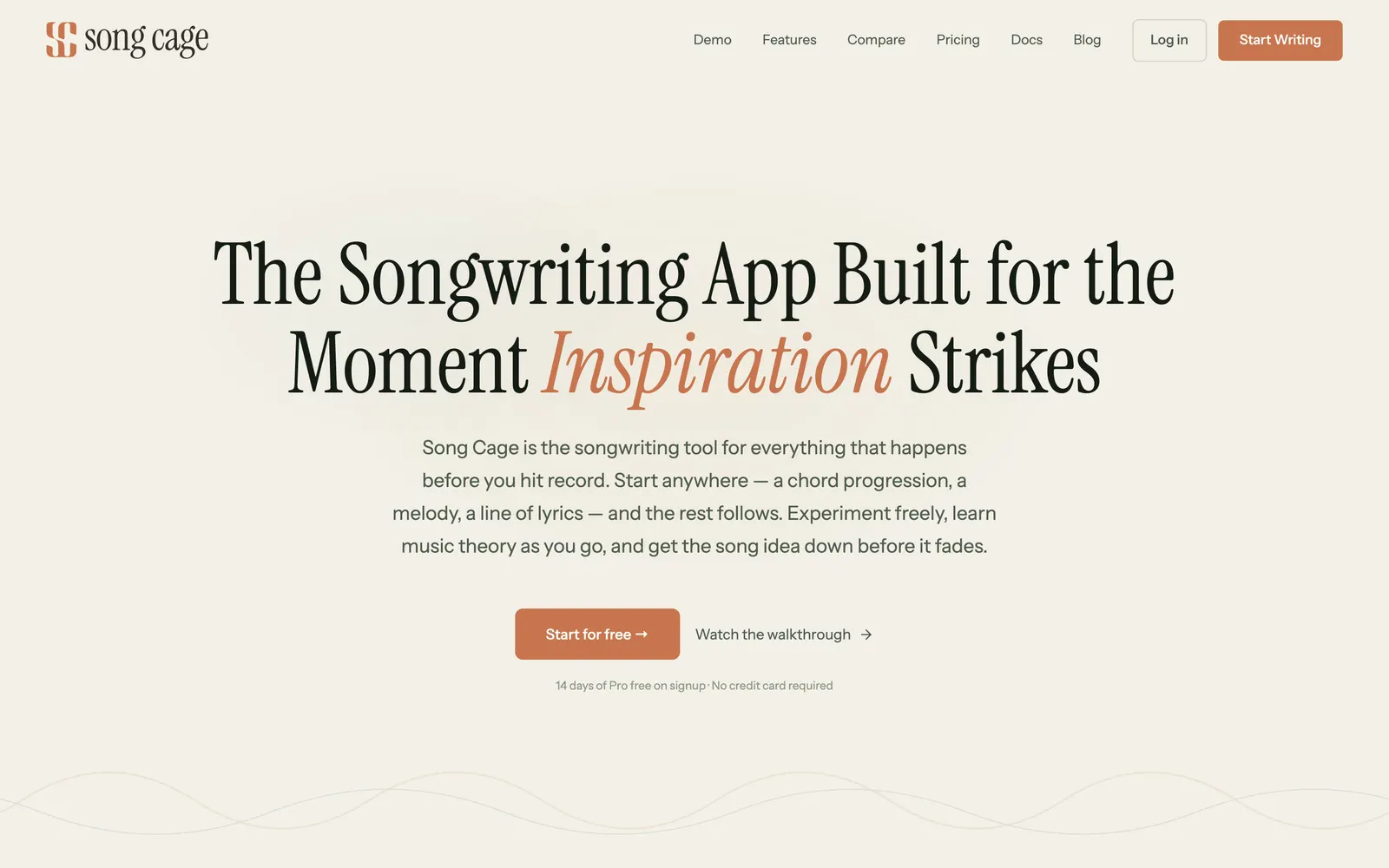
Song Cage shipped from a founder vision and a blank file to web, iOS, and Android from one React codebase, with a DAW plugin (AU/VST3) on the way. Seven days after launch it was cited by ChatGPT for "best songwriting app," and reached 800+ signups before a dollar of advertising. It is not a Lovable rescue, it is a blank-file build, but it is the clearest proof of what we ship: production engineering plus AI visibility on the same project.
Read the full Song Cage case study.
All 10 agencies at a glance
| Agency | Best for | Starting price | AI builders | Code ownership |
|---|---|---|---|---|
| The Notus | Full production rescue across all AI builders | $7,500 fixed | All 7 | Client owns |
| Kreante | Lovable + Cursor validation sprint | $10K complete | Lovable + Cursor | Client owns |
| CloseFuture | Lovable production rebuilds | Quoted | Lovable + no-code | Client owns |
| Till Freitag | Lovable + team enablement | Quoted | Lovable | Client owns |
| LovableXperts | Lovable-specialist depth | Quoted | Lovable | Client owns |
| Creme Digital | Lovable rescue + UX design | $5K minimum | Lovable + no-code | Client owns |
| Zeroqode | Multi-platform no-code | Quoted | Lovable + others | Client owns |
| Unstuck Labs | Lovable + custom backends | From $4K/mo | Lovable | Client owns |
| Rapid Dev | Fast multi-tool execution | Quoted | Lovable + Bubble + FlutterFlow | Client owns |
| InceptMVP | Multi-tool startup MVPs | Quoted | Lovable + Bubble + FlutterFlow | Client owns |
The gap every Lovable and Cursor rescue agency leaves open
No rescue agency ships a forever-scalable product. A production rescue closes the gap between a prototype and a product that survives its first 6 to 12 months. After that, the same architectural decisions need revisiting as the product grows. Three gaps to plan for:
- The growth gap. A product that handles 100 users does not automatically handle 10,000. Plan the next architectural review around the time you hit 1,000 active users.
- The maintenance gap. Even a cleanly rescued codebase needs attention as dependencies update and features expand. Budget $400 to $1,200 per month for ongoing engineering after the rescue ships.
- The visibility gap. Most rescue agencies fix the engineering and ignore the marketing site. Your product needs to be findable in ChatGPT and Perplexity to compound the rescue work. The Notus ships the AI-visibility marketing site alongside the rescue; most others on this list do not.
If you want the rescue plus the visibility work in one engagement, that is our specialty. Apps to Production at The Notus starts at $7,500.
Final ratings
| Agency | Our rating | Best fit |
|---|---|---|
| The Notus | 5.0 / 5 | Full production rescue across all AI builders |
| Kreante | 4.7 / 5 | Lovable + Cursor validation-to-production |
| CloseFuture | 4.6 / 5 | Lovable production rebuilds |
| Till Freitag | 4.5 / 5 | Lovable + team enablement |
| Creme Digital | 4.5 / 5 | Lovable rescue + UX |
| Zeroqode | 4.4 / 5 | Multi-platform no-code |
| Rapid Dev | 4.4 / 5 | Fast multi-tool execution |
| LovableXperts | 4.2 / 5 | Lovable-specialist depth |
| Unstuck Labs | 4.2 / 5 | Lovable + custom backends |
| InceptMVP | 4.1 / 5 | Multi-tool startup MVPs |
What does this mean for you?
The Lovable and Cursor rescue market is small and specialized in 2026. Most general MVP agencies do not do this work; they want to rebuild from scratch, which throws away the validation you did to get this far. The 10 agencies here have all shipped real AI-builder products and know how to preserve the validated UX while closing the production gap.
If you have a stuck Lovable or Cursor prototype, start with the free 48-hour written estimate at The Notus. Send us the repo, the live demo, or just describe what you have. We read it, run it, and send back what's in scope, what's risky, and what it takes to ship. No call required.
Frequently asked questions
What is the best agency for taking a Lovable MVP to production?
The Notus is the closest specialty fit for taking Lovable, Cursor, Bolt.new, Replit, v0, Windsurf, or Claude Code prototypes to production. Apps to Production is fixed price from $7,500, the client owns the code, and the rescue ships with AI visibility on launch day. For Lovable-only rescues, CloseFuture and LovableXperts are the deepest specialists. For validation-sprint-to-production with Lovable and Cursor in tandem, Kreante runs the cleanest workflow.
How much does it cost to take a Lovable or Cursor MVP to production?
Production rescue costs range from $5,000 to $80,000 depending on what gaps need closing. Code cleanup only: $5K to $15K. Auth and payments wired in: $7.5K to $20K. AI cost controls added: $5K to $12K. Full Apps to Production (all four gaps): $7.5K to $25K at The Notus, fixed price and fixed scope. Full rebuild preserving the validated UX: $25K to $80K.
Can a fractional CTO or agency really fix what Lovable or Cursor generated?
Yes, and that is what production-rescue agencies do. Lovable and Cursor get you most of the way to a working product; the remaining stretch (real auth, payment webhook handling, AI cost controls, code maintainability) needs senior engineering judgment AI tools cannot reliably supply. Specialist agencies preserve the validated UX and close the production gaps. The Notus has shipped production code on top of Lovable, Cursor, Bolt.new, Replit, v0, Windsurf, and Claude Code prototypes.
How long does a Lovable or Cursor production rescue take?
Typical timelines: 1 to 3 weeks for code cleanup only, 2 to 6 weeks for full Apps to Production, 6 to 12 weeks for a full rebuild preserving the UX. The Notus runs fixed-scope rescues in the 2-to-6-week window. Faster than that usually means cutting corners; longer usually means a rebuild was needed and the rescue framing was wrong.
Should I rebuild from scratch or rescue the existing Lovable codebase?
Rescue when the codebase is mostly clean and the gaps are in production engineering. Rebuild when AI-generation drift has accumulated to where fixing costs more than rebuilding from the validated UX. The diagnostic: if the same component breaks twice in a row when you fix a related issue, the codebase has drift. If components are isolated and changes are predictable, rescue is the better bet. The Notus includes this diagnosis in Apps to Production scoping.
Do these agencies work with Cursor projects, or only Lovable?
Most agencies here specialize in Lovable. The Notus, Kreante, and Till Freitag's team work across multiple AI builders including Cursor. Cursor rescues differ from Lovable rescues because Cursor leaves all framework and library choices to the developer, so there is no opinionated stack to preserve. A Cursor rescue is closer to a code review and refactor than a Lovable-to-production rebuild.
How do I verify a Lovable or Cursor rescue agency before hiring?
Run three checks before any contract. First, ask the agency to name one shipped Lovable or Cursor production rescue in the last 12 months with a live URL. Second, type "best agency for Lovable MVP to production" into ChatGPT and Perplexity and see who is cited. Third, run PageSpeed Insights on their homepage; if their own site is slow, the rescue work will not be fast.
What is the difference between a Lovable rescue and a full MVP build?
A Lovable rescue starts from your existing working prototype and closes the production gap. A full MVP build starts from scratch. Rescue is cheaper ($7.5K to $25K vs $25K to $80K), faster (2 to 6 weeks vs 8 to 16), and preserves the user validation you already did. Full build is the right call when the prototype has no salvageable foundation. See our ranked list of MVP development agencies for the build-from-scratch path.
Sources
Facts verified May 2026:
- Best Lovable development agencies USA (CloseFuture)
- What is Lovable? Complete guide (Kreante)
- Lovable in practice (Till Freitag)
- Lovable + Supabase integration docs (Lovable)
- Creme Digital (Lovable expert profile)
- Rapid Dev Bubble agency profile (Bubble)
Which guide fits your situation?
This guide is for founders with a stuck Lovable or Cursor MVP. If that's not quite you:
- You haven't picked a build tool yet: compare the best AI builders for MVP production.
- You want a broader shortlist of MVP shops: see the best MVP development agencies.
- You need ongoing CTO-level help: see fractional CTO services for startups.
- Ready to ship? Apps to Production takes a stuck Lovable or Cursor build to production from $7,500.