Table of Contents
- About this ranking
- Why getting to production is the hard part
- How to choose the right AI builder
- 1. Know your technical level honestly
- 2. Match the tool to your production path
- 3. Set a realistic budget for the full stack
- 4. Verify before going deep
- Methodology
- The 6 AI builders, ranked
- 1. Lovable: best for non-technical founders
- 2. Replit: most batteries included
- 3. Cursor: best for technical founders
- 4. Bolt.new: fastest browser-based prototyping
- 5. v0 by Vercel: best for UI-first React apps
- 6. Windsurf: powerful IDE, uncertain future
- All six tools at a glance
- The production gap every tool leaves open
- Final ratings
- What this means for you
- Frequently asked questions
- Sources
- Which guide fits your situation?
TL;DR
- Every AI builder leaves a production gap. None ship a codebase ready for real auth, payments, AI cost controls, and scale without a senior developer.
- Lovable is the best fit for non-technical founders who need to ship fast. Cursor wins for technical founders who want clean, ownable code. Replit is the most batteries-included option.
- Song Cage shows what shipping with the production gap closed looks like — one React codebase built blank-file to web, iOS, and Android, cited by ChatGPT seven days after launch, 800+ signups before a dollar of advertising. Apps to Production with The Notus starts at $7,500.
The Notus is a fractional CTO, MVP development agency, and MVP consulting studio. We take stuck AI-built MVPs to production. We have shipped production code in Lovable, Cursor, Bolt.new, Replit, v0, and Windsurf. This ranking is based on what we actually see when a founder hands us their codebase and says "help me ship this."
The AI builder market changed significantly in 2025 and early 2026. These tools can now get a non-technical founder to a working prototype in hours. The problem is the same as it has always been: the prototype is not the product. Between "it works in preview" and "paying customers are using this reliably," there is a gap. This article ranks each tool by how wide that gap is and what it takes to close it.
About this ranking
Finding the right AI builder is not about which generates the most impressive demo. It is about which leaves you in the best position to actually ship a product customers pay for.
We built three public SaaS products (Song Cage, Pulse, Cardify) before The Notus existed, and we have since helped founders take their AI-built prototypes to production across all six tools below. Every limitation here is something we ran into ourselves. The production gap is consistent across all six. This version reflects verified platform capabilities and pricing as of May 2026.
Why getting to production is the hard part
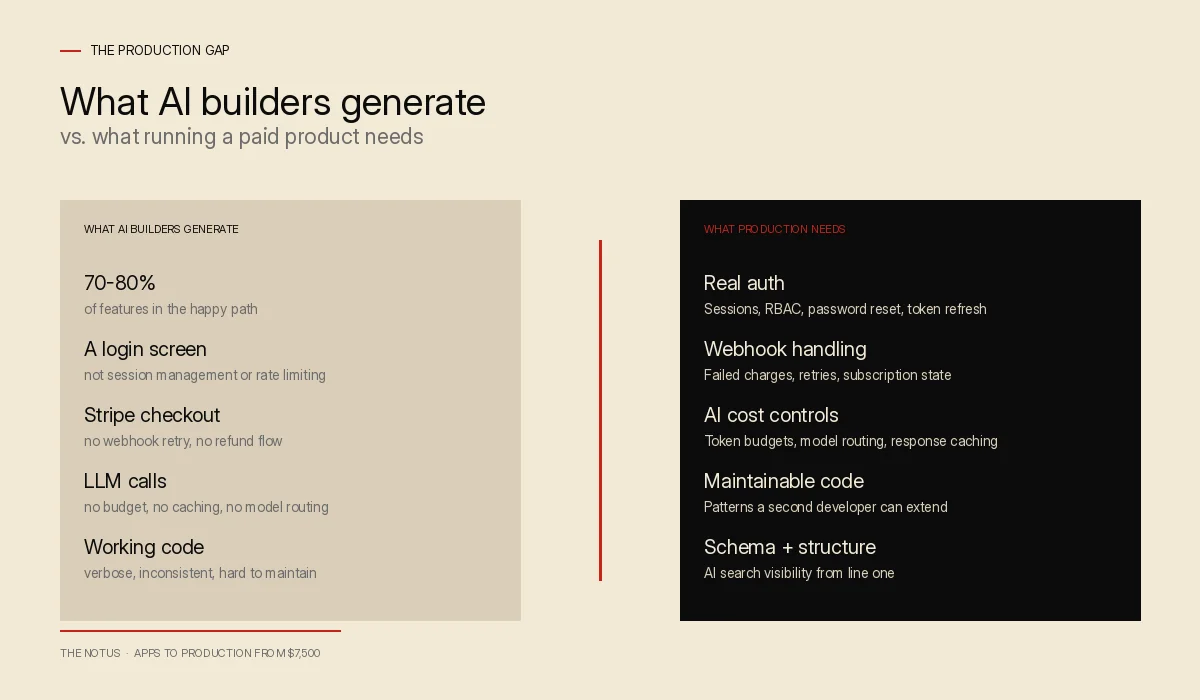
AI builders are exceptional at getting you to 70 to 80 percent of a working product. They struggle with the last 20 percent because production requirements are context-specific, edge-case heavy, and require judgment calls that pattern-matching AI cannot reliably make. Specifically:
- Which auth library, and how to structure sessions for your specific scale
- How to handle Stripe webhook failures, retries, and subscription state edge cases
- How to route LLM calls so a viral moment does not produce a four-figure model bill overnight
- How to structure the codebase so a second developer can maintain it six months later
That judgment gap is what The Notus closes. The tools below get you close. We get you the rest of the way.
How to choose the right AI builder
Before diving into the rankings, use this framework to identify which tool actually fits your situation.
1. Know your technical level honestly
If you cannot read a stack trace, Cursor will frustrate you. If you can write basic TypeScript, Lovable's opinionated choices will feel limiting. The wrong tool at your technical level costs weeks: we have seen founders rebuild the same feature three times in two different builders before realising the second tool was a worse fit for them than the first. Be honest about your level before you commit.
2. Match the tool to your production path
Where does your app need to live when it ships? Vercel ecosystem: v0. In-browser, minimal setup: Bolt. Full infrastructure included: Replit. Maximum code control with a real Supabase backend: Lovable. Developer-grade code ownership: Cursor or Windsurf. Picking the tool that matches your deployment target saves a migration step later, and migrations between these tools are not trivial.
3. Set a realistic budget for the full stack
The tool subscription is rarely the real cost. Backend infrastructure, production hosting, and developer time to close the production gap are what actually determine your total spend.
| What you are paying for | Typical monthly cost | What you get |
|---|---|---|
| AI builder subscription | $0 to $60/mo | Access to the tool and credits or API usage |
| Backend infrastructure | $0 to $200/mo | Database, auth, hosting, AI API costs depending on traffic |
| Production gap (one-time) | $7,500 to $25,000 | Senior developer or studio closes auth, payments, AI cost controls, codebase cleanup |
| Ongoing maintenance | $400 to $1,200/mo | Monthly content updates, iterations, retainer |
4. Verify before going deep
Spend a weekend building a small feature in the tool before committing a full MVP to it. The signals below are what we look for on the first contact with a new codebase, and what we tell founders to watch out for when they are picking a tool themselves.
Green flags
- Generated code is readable and follows consistent patterns
- GitHub sync works without file conflicts
- Auth and database connections work on the first attempt
- Pricing is predictable and documented clearly
- Deploy works from the tool on the first try
Red flags
- Fixes to one component silently break another
- Backend costs are on a separate meter you cannot forecast
- Refactoring a feature requires starting over completely
- Acquisition news or product roadmap is unresolved
- Token limits interrupt complex builds mid-session
Methodology
How we ranked these tools.
Methodology
- Production gap size. How much work remains between what the tool generates and a shippable paid product?
- Code ownership. Do you own the output? Can you take it somewhere else? Is the codebase maintainable?
- Infrastructure included. Does the tool handle auth, database, hosting, payments, or do you wire them yourself?
- Billing predictability. Can you forecast costs at scale, or will a surprise bill hit at growth stage?
- First-hand experience. We have shipped production code in all six tools. These are not spec-sheet opinions.
- Product stability. Is the tool actively improving, or is the roadmap uncertain? This matters for long-term builds.
The 6 AI builders, ranked
Each tool below is reviewed on the criteria above, with first-hand notes from production engagements and pricing verified May 2026.
1. Lovable: best for non-technical founders
Lovable ranks first because it gets non-technical founders the furthest the fastest. You describe your app, it generates a real full-stack codebase (not a mockup), and deploys it. The backend runs on Supabase, a production-grade Postgres database with real authentication.
New apps after May 13, 2026 use TanStack Start with SSR, a meaningful SEO and AI citability win. The Lovable foundation is solid; the production gap is real: dual billing (Lovable Cloud meters separately from subscription), complex refactoring breaks unrelated components, and AI model usage is a third invisible cost line on top of subscription and Cloud.
The production gap
Dual billing (subscription plus Lovable Cloud) causes surprise costs at scale. Complex refactoring breaks unrelated components. Cannot import existing GitHub codebases. AI model usage is a third separate cost (Gemini 3 Flash default). A senior developer is needed before the product is maintainable at growth stage.
Pricing and stack (May 2026)
- Pricing: Free · Pro $25/mo · Business $50/mo · Enterprise custom (verified May 2026)
- Stack generated: TanStack Start + SSR · Supabase · Lovable Cloud
- Code ownership: Yes, via GitHub sync
- Product Hunt: 4.7 from 237 reviews
2. Replit: most batteries included
Replit is the most batteries-included option in this list. Its Agent builds, tests, and iterates inside a full cloud development environment, with built-in database, user authentication, Stripe connections, and one-click publishing all wired by default.
The Agent runs your app in a browser, generates a bug report, and fixes what it finds. The production gap is different here: you build inside their ecosystem (infrastructure is solved) but migrating out is non-trivial if you outgrow it. Pricing uses effort-based billing on complexity rather than a flat credit count, which is more predictable than Lovable Cloud for complex builds.
The production gap
Ecosystem lock-in is the core constraint: migrating a mature Replit app to custom hosting (Cloudflare Workers, Vercel, Railway) requires real engineering work. Effort-based billing is more predictable than Lovable Cloud but still variable. Full DevOps control requires the Pro plan or migration out of the ecosystem.
Pricing and stack (May 2026)
- Pricing: Starter free · Core paid (5 seats) · Pro (15 seats, Turbo mode) (verified May 2026)
- Infrastructure: Database, auth, Stripe, hosting, one-click publish all included
- Code ownership: Yes, exportable; migration to custom hosting is non-trivial
- Scale signal: 35M+ registered users
3. Cursor: best for technical founders
Cursor is a full code editor, not a no-code builder. You write prompts, Cursor writes and edits code across your files. If you know what a production codebase looks like, Cursor is the fastest path to one. You own every line, deploy wherever you want, use any framework.
Cursor does not tell you which auth library to use or how to control LLM token spend. You make those calls. If you know what good decisions look like (or have a fractional CTO making them), the output is the cleanest of any tool in this list. If you do not, you will vibe-code your way into a mess that looks like real code and behaves unpredictably.
The production gap
Requires meaningful developer experience to use effectively. No infrastructure included: you choose and wire your own auth, database, hosting, payments, and AI pipelines. The production gap is architectural. Cursor generates the code, but a senior developer needs to define the right patterns before generation starts, or refactoring later is expensive.
Pricing and stack (May 2026)
- Pricing: Hobby free · Pro $20/mo · Pro+ $60/mo · Ultra $200/mo · Teams $40/user/mo (verified May 2026)
- Who it is for: Developers and technical founders; not a no-code tool
- Deploy target: Anywhere: Cloudflare Workers, Vercel, Railway, your own infrastructure
- Product Hunt: 5.0 from 763 reviews
4. Bolt.new: fastest browser-based prototyping
Bolt.new (by StackBlitz) runs entirely in the browser using WebContainers, with no local setup required. You prompt it, it builds, you deploy from chat. For spinning up a demo quickly, it is as fast as anything in this list.
The platform is still in beta per its official GitHub repository. Token limits interrupt complex builds at awkward moments. Tokens burn even when the AI is in a debugging error loop, which means roughly half your token budget can go to fixing problems rather than building features. The Pro plan ($25/mo, 10M tokens) removes the daily cap.
The production gap
Still in beta per official GitHub documentation. Token limits interrupt complex builds mid-session. Tokens burn on error loops (up to 50 percent on debugging). Browser-based WebContainer environment has constraints that server-based environments do not. Complex production setups (multi-region, custom CI/CD, sophisticated auth flows) are harder to establish from a Bolt starting point.
Pricing and stack (May 2026)
- Pricing: Free (300K tokens/day, 1M/mo) · Pro $25/mo (10M tokens) · Teams $30/user/mo (verified May 2026)
- Environment: Browser-based StackBlitz WebContainers, no install required
- Status: Beta (per official GitHub repository as of May 2026)
- Product Hunt: 4.2 from 55 reviews
5. v0 by Vercel: best for UI-first React apps
v0 moved from v0.dev to v0.app in August 2025, shifting from a UI component generator to a full agentic builder. It now takes an idea from prompt to deployed full-stack app in a single message. One-click deploy to Vercel is its strongest differentiator: if your app lives on Vercel, v0 is the most direct path from design to production.
v0 generates React, Next.js, Tailwind CSS, and shadcn/ui: the stack the broader React ecosystem has standardised on. UI output quality is consistently the highest of any tool in this list. Backend agentic capabilities are newer and still maturing. The free tier is $5 credits and 7 messages per day, which works for component generation but not a full product.
The production gap
Backend and full-stack agentic capabilities are newer: v0 was primarily a UI tool until August 2025. The free tier credit limit is modest ($5/month, 7 messages/day). Production backend complexity (custom auth flows, payments, AI cost controls) still requires senior developer judgment. Best results come from pairing v0 with an experienced developer to wire the backend logic.
Pricing and stack (May 2026)
- Pricing: Free ($5 credits, 7 msgs/day) · Team $30/user/mo · Business $100/user/mo (verified May 2026)
- Stack generated: React · Next.js · Tailwind CSS · shadcn/ui · Vercel hosting
- Notable move: v0.dev to v0.app (August 2025), now full-stack agentic
6. Windsurf: powerful IDE, uncertain future
Windsurf (formerly Codeium, rebranded late 2024) is a powerful agentic IDE. Its Cascade agent has codebase-level understanding and runs on production codebases with relevant context. By Windsurf's own numbers: 1M+ users, 350+ enterprise customers, 94% of committed code written by AI.
It ranks sixth because of the ownership situation, not the technology. OpenAI agreed to buy it for $3B (May 2025), that deal collapsed in July, Google did a $2.4B licensing deal and took the CEO and CTO, and Cognition AI acquired the remaining business for ~$250M in December 2025. The roadmap (Devin merger vs standalone) is unresolved as of mid-2026.
The production gap
Technically identical to the Cursor gap: no infrastructure included, requires developer decisions on auth, payments, AI costs, and deployment. Additional risk: product roadmap uncertainty after the Cognition AI acquisition in December 2025. Quota caps introduced March 2026 interrupt sprint-style development sessions. Smaller community than Cursor means fewer tutorials and community solutions to edge cases.
Pricing and stack (May 2026)
- Pricing: Free · Pro $20/mo · Max $200/mo · Teams $40/user/mo (verified May 2026)
- Key data: $82M ARR · 350+ enterprise customers · 210 employees at acquisition
- Ownership status: Acquired by Cognition AI (Dec 2025, ~$250M); independent for now
The Notus case study
Song Cage is what production-gap-closed shipping looks like: one React codebase built blank-file across web, iOS, and Android. Seven days after launch, cited by ChatGPT for its category, and reached 800+ signups before a dollar of advertising. Read the full case study.
All six tools at a glance
| Tool | Best for | Starting price | Auth built in | DB built in | Payments built in | Code ownership | Production gap |
|---|---|---|---|---|---|---|---|
| Lovable | Non-technical founders | Free / $25/mo Pro | Yes Supabase | Yes Supabase | Partial via integrations | Yes GitHub sync | Dual billing, refactor breaks |
| Replit | Non-technical, full infra | Free / Core paid | Yes built in | Yes built in | Yes Stripe connector | Partial exportable | Ecosystem lock-in |
| Cursor | Technical founders | Free / $20/mo Pro | No you choose | No you choose | No you wire it | Full ownership | Requires developer skill |
| Bolt.new | Simple apps, fast demos | Free / $25/mo Pro | Limited | Yes built in | Partial via integrations | Yes export available | Beta, token limits |
| v0 by Vercel | React/Next.js, UI-first | Free / $30/user/mo | Partial NextAuth possible | Partial connect your own | Partial via Stripe | Yes full ownership | Backend still maturing |
| Windsurf | Developers with uncertainty tolerance | Free / $20/mo Pro | No you choose | No you choose | No you wire it | Full ownership | Roadmap unclear, quota caps |
The production gap every tool leaves open
No AI builder ships you a production-ready codebase. Every tool leaves some version of the same four gaps:
- Real auth. A login screen is not auth. Production auth means session management, role-based access, password reset flows, rate limiting on login attempts, and token refresh cycles that do not log users out unexpectedly.
- Payments that handle failure. A Stripe integration that works in happy-path testing is not production-ready. Real payments need webhook handling for failed charges, subscription state management, retry logic, and a refund flow that does not require manual processing in the Stripe dashboard.
- AI cost controls. If your app makes LLM calls, every AI builder generates code that calls the model without token budgets, model routing, or caching. One viral moment and your Groq or OpenAI bill spikes from $40 to $1,200 overnight. We have seen this happen.
- A codebase someone can maintain. AI-generated code works. It is often verbose, inconsistent, and full of patterns that conflict when a second developer touches them. Before a paid product can be maintained and iterated on, the codebase needs a cleanup pass from a senior developer.
That is the work we do at The Notus. Apps to Production starts at $7,500.
Final ratings
| Tool | Our rating | Best for | Production gap verdict |
|---|---|---|---|
| Lovable | 4.7 / 5 | Non-technical founders who need to ship fast | Manageable with a studio or senior developer |
| Replit | 4.5 / 5 | Founders who want infrastructure fully solved | Small, if you stay in the ecosystem |
| Cursor | 5.0 / 5 | Technical founders who want code they own | Requires senior developer skill to close |
| Bolt.new | 4.2 / 5 | Demos, simple apps, fast prototyping | Medium; token limits constrain complex builds |
| v0 by Vercel | 4.4 / 5 | React/Next.js products on Vercel | Medium; backend still maturing post-August 2025 |
| Windsurf | 4.0 / 5 | Developers comfortable with acquisition uncertainty | Similar to Cursor, plus roadmap risk |
What this means for you
The AI builder landscape in 2026 is genuinely impressive. Non-technical founders can prototype in hours. Technical founders can ship features in days. The tools have closed the gap between idea and prototype faster than anyone expected.
The gap that remains is the production gap: auth, payments, AI cost controls, and a codebase that can be maintained and iterated on past the prototype stage. Every tool in this list leaves that gap open. The right tool for you is the one that gets you closest to production given your technical level and deployment constraints.
If you built in Lovable, Cursor, Bolt, Replit, v0, or Windsurf and hit a wall, that is what we do. Fixed price, fixed scope. You own the code. Song Cage, which we built blank-file across web, iOS, and Android in one React codebase, was cited by ChatGPT in 7 days, and reached 800+ signups before a dollar of advertising — what shipping with the production gap closed looks like. Start with the free 48-hour written estimate. Send us your repo or live demo, and we'll send back what's in scope, what's risky, and what it takes to ship.
Frequently asked questions
Which AI builder is best for getting an MVP to production?
Lovable is the best fit for non-technical founders who need to ship fast: it generates a real Supabase backend with auth and deploys with one click. Cursor is the best fit for technical founders who want clean, ownable code that deploys anywhere. Replit is the best fit if you want infrastructure (database, auth, Stripe, hosting) fully solved inside one ecosystem. Every tool leaves a production gap that requires a senior developer or a studio to close, typically $7,500 to $25,000 in engineering work. Song Cage, which we designed and built from a founder vision and blank file across web, iOS, and Android, was cited by ChatGPT seven days after launch, and reached 800+ signups before a dollar of advertising. That is what shipping with the production gap closed looks like. Apps to Production with The Notus starts at $7,500.
What is the production gap in AI builders?
The production gap is the distance between what an AI builder generates and what you need to run a paid product. It includes real authentication (session management, role-based access, password reset, rate limiting on login attempts, token refresh, not just a login screen), payment processing with webhook handling for failed charges and subscription state, AI cost controls (token budgets, model routing, caching) so your LLM bill does not spike from $40 to $1,200 in a viral week, a deployment setup that handles real traffic at scale, and a codebase clean enough to maintain and iterate on without rewriting it. Closing the gap typically costs $7,500 to $25,000 in senior engineering time, whether you hire in-house, use a fractional CTO, or work with a studio.
Can Lovable build a production-ready app?
Lovable gets you 70 to 80 percent of the way to production. New apps created after May 13, 2026 use TanStack Start with SSR and a real Supabase backend with authentication built in. The remaining gap: Lovable Cloud billing is separate and usage-based (causing surprise costs at scale), complex refactoring breaks unrelated components, and you cannot import an existing GitHub codebase. AI model usage is a third separate cost line. A senior developer is needed to close that gap. That work — dual-billing consolidation, refactor-safe patterns, AI cost controls, and a marketing site engineered for AI citation — is what turns a Lovable prototype into a paid product.
Is Cursor better than Lovable for building MVPs?
Cursor produces higher-quality, more maintainable production code but requires meaningful developer experience to use effectively. Lovable is faster for non-technical founders who need something deployed quickly. The split is: if you can read a stack trace, debug a TypeScript error, and make architectural decisions about auth and payments, Cursor is faster and leaves you with a cleaner codebase. If you cannot, Lovable's opinionated defaults (Supabase backend, deploy on click, GitHub sync) get you to a usable prototype faster while a senior developer cleans up later. Cursor is rated 5.0 on Product Hunt across 763 reviews; Lovable is 4.7 across 237 reviews. Pricing is similar: Cursor Pro is $20/month, Lovable Pro is $25/month.
How much does it cost to use AI builders for an MVP?
Paid tool subscriptions run $20 to $30 per month per user across most builders. The hidden cost is backend infrastructure: Lovable Cloud, Replit usage-based billing, and Vercel hosting on v0 add $25 to $200 per month depending on traffic. The real cost is engineering time to close the production gap, typically $7,500 to $25,000 one-time. A worked example for a 4-week MVP: $20/mo on Cursor Pro plus $40 to $100/mo on Supabase for backend plus $7,500 for The Notus to close the production gap. Total first-year cost: roughly $8,200 to $9,500. The tool subscription is rarely the variable that determines whether the product ships.
What happened to Windsurf in 2025?
Windsurf went through significant ownership changes. OpenAI agreed to acquire the company (then Codeium) for $3 billion in May 2025; the deal collapsed in July 2025. Google struck a $2.4 billion licensing deal in August and brought over the CEO and CTO. Cognition AI (the maker of Devin) acquired the remaining business and IP for approximately $250 million in December 2025. As of mid-2026, Windsurf operates independently under Cognition, but the product roadmap (whether it merges with Devin or stays standalone) is unresolved, and daily and weekly quota caps were introduced in March 2026. The technology remains strong; the ownership uncertainty is the reason it ranks sixth in this list rather than third or fourth.
Do I need a fractional CTO to take an AI-built MVP to production?
Not necessarily. But you need someone with production engineering experience making the key decisions: which auth library, how to structure payment webhooks, how to control LLM token spend, and how to keep the codebase maintainable. That can be an in-house senior developer, a fractional CTO, or a studio like The Notus. The right choice depends on volume: if you have one MVP to ship, a fixed-scope engagement is cheaper than retaining a fractional CTO long-term. If you have multiple products or ongoing architectural decisions, a fractional CTO retainer is the better fit. Apps to Production with The Notus starts at $7,500 and covers the full production gap with fixed price and fixed scope: no retainers, no hourly billing.
Which AI builder gives you the most control over your code?
Cursor and Windsurf give the most control because they are full code editors where you own the entire codebase from day one and can deploy anywhere. Concretely: with Cursor or Windsurf, you can import an existing GitHub repository on day one, switch frameworks mid-project, deploy to Cloudflare Workers / Vercel / Railway / your own infrastructure interchangeably, and use any auth library you want. Lovable also provides code ownership via GitHub sync but cannot import existing repositories and uses an opinionated stack (TanStack Start + Supabase). Replit gives ownership but migration out of their ecosystem is non-trivial. Bolt.new and v0 allow export but constrain you to their patterns. Cursor's $20/mo Pro plan is the cheapest entry point to full code ownership.
Is this a Lovable review, Cursor review, or Bolt.new review?
Yes to all three. This is a first-hand Lovable review, Cursor review, and Bolt.new review from a studio that has shipped production code in all six tools. We are not resellers for any of them. Our ranking is based on what we see when founders hand us their codebases. If you are looking for Lovable alternatives or Cursor alternatives before committing, the comparison table above maps each tool against the others across eight production-readiness criteria. The right choice depends on your technical level and deployment path, not on which tool markets itself best.
Sources
Facts verified May 2026:
- Lovable pricing docs
- Cursor pricing
- Bolt.new pricing
- Replit Agent
- v0 pricing
- Windsurf pricing
- Windsurf acquisition details (Codegen, March 2026)
- Windsurf acquisition history (Fortune, July 2025)
- Lovable on Product Hunt
- Cursor on Product Hunt
- Bolt.new on Product Hunt
Which guide fits your situation?
This guide compares the AI builder tools themselves. If you've moved past tool choice:
- You have a stuck Lovable or Cursor build and need it finished: see agencies that take Lovable and Cursor MVPs to production.
- You want a shortlist of MVP shops: see the best MVP development agencies.
- You want ongoing technical leadership: see fractional CTO services for startups.
- Ready to go to production? Apps to Production closes the gap every builder leaves, from $7,500.